
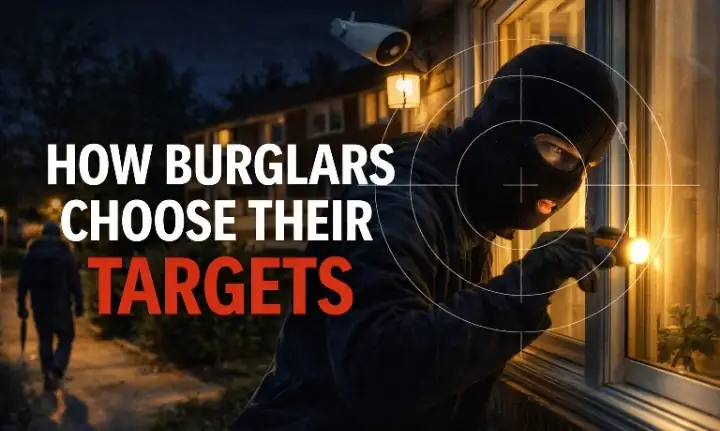
How Burglars Choose Their Targets (And How to Avoid Being One in 2026)
I still remember the moment I realized my home was being watched. It was a Tuesday afternoon, and I was working from my kitchen table when I noticed a white sedan circling my block for the third time. The driver wasn’t lost—he was studying us. That slow, deliberate loop told me everything I needed to know about how burglars choose their targets.
Three days later, my neighbor’s house was hit. They’d left for a weekend trip, posted about it on Instagram, and forgotten to set their porch light timer. The burglars knew exactly when to strike because my neighbors had unknowingly broadcast their vulnerability to the world. That incident changed how I think about home security forever.
Understanding how burglars choose their targets isn’t about living in fear—it’s about making your home the one they skip. In 2026, burglary tactics have grown, but so have our defenses. Residential burglaries dropped 19% in the first half of 2025 compared to 2024, yet a break-in still occurs every 26 seconds nationwide in 2026.
I’ve spent years researching criminal psychology, interviewing security experts, and implementing layered protection strategies in my own home. What I’ve learned is that burglars are rational actors making calculated decisions. When you understand their decision-making process, you can flip the script and make your property invisible to their radar.
The Psychology Behind Target Selection
Burglars aren’t random criminals striking blindly—they’re opportunity seekers running a mental cost-benefit analysis. Recent criminological research identifies two distinct burglar profiles: “Organised Suburbanites” who target older, accessible terrace properties methodically, and “New Build Opportunists” who focus on modern homes with predictable layouts.
The typical burglar operates within a limited geographic comfort zone. Studies across the Netherlands, UK, and Australia confirm that offenders prefer neighborhoods close to their homes, with each kilometer of distance reducing selection likelihood by 67-90% depending on the region. They know the escape routes, the busy streets, and which houses look promising.
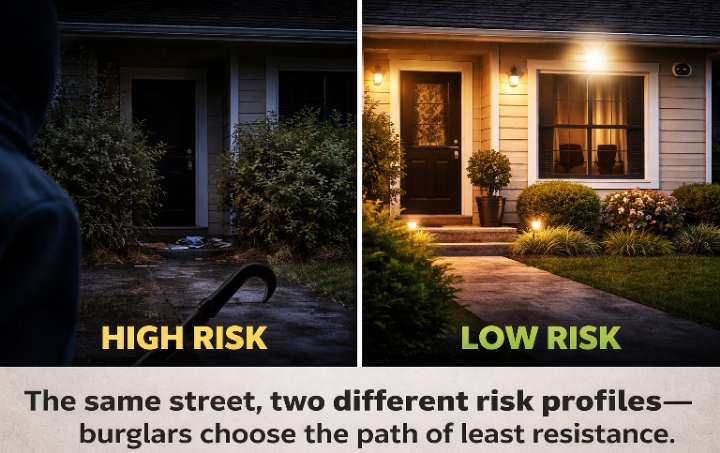
Most burglaries are crimes of opportunity rather than sophisticated heists. The burglar cruising your neighborhood isn’t looking for a challenge—they’re looking for the path of least resistance. My own research and experience show that three factors dominate their target selection: ease of entry, signs of absence, and visible valuables.
The Problems: Why Your Home Might Be a Target
Environmental Cues That Scream “Easy Target”
Your property speaks to burglars before you ever open the door. Overgrown landscaping provides cover. Poor lighting creates shadows for hiding. Unmaintained exteriors suggest absent owners or renters who don’t pay attention to details. These environmental cues form the foundation of Crime Prevention Through Environmental Design (CPTED) theory, which shows how criminals perceive risk.
I learned this lesson the hard way when I first bought my house. The previous owner had let the hedges grow wild, creating perfect cover around the ground-floor windows. Within my first month, I noticed footprints in the mulch beneath my bedroom window. The message was clear: someone had tested my defenses and found them lacking.
Environmental psychology research shows that burglars favor targets they can approach and leave quickly without being seen. Clear sightlines from the street, low fences, or overgrown landscaping give them the concealment they need. Easy access points such as sliding doors, side gates, or poorly secured back entrances increase the perceived reward because they make entry faster and quieter.
Digital Footprints and Social Media Oversharing
In 2026, your Instagram feed is a reconnaissance tool. That vacation countdown story? A burglar’s schedule. The “Working from home today” check-in? Confirmation of your daily routine. The package unboxing video showing your new TV? A shopping list.
Research from 2025 shows that 61.1% of women post on social media when away from home, potentially alerting would-be burglars of an easy target. I’ve seen friends post real-time airport photos with captions like “Two weeks in Bali starts now!” while their house sits empty. To a criminal scrolling through location tags, that’s not sharing—it’s intelligence.
The “No One’s Home” Signals
Burglars look for accumulated mail, unlit rooms at night, or social posts announcing travel. These indicators signal low risk and high reward. Small changes such as using timers for lights, asking a neighbor to collect mail, or leaving some interior lights on can reduce the chance your property looks empty.
During my neighborhood watch meetings, I’ve heard countless stories about burglars who struck during daylight hours when they knew residents were at work. Contrary to popular belief, most break-ins happen between 10 AM and 3 PM, not at midnight. Burglars prefer empty houses, and they know exactly when you’re likely to be gone.
Solutions & Tips: Flipping the Script on Burglar Psychology
Layer 1: Visible Security That Speaks Volumes
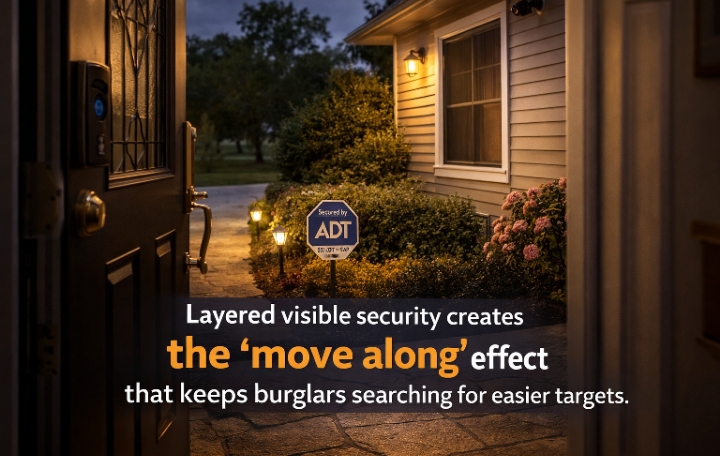
I’ve installed a comprehensive security system not because I expect to catch a burglar in the act, but because I want them to see it and keep driving. Visible cameras, alarm signage, and motion-activated lighting send an immediate message: this house is protected, choose somewhere else.
Data from 2025 shows that 83% of would-be burglars check for alarm systems before attempting a break-in, and 60% avoid homes with visible alarms or signs entirely. Only 13% continue if they discover an alarm mid-attempt. These aren’t just statistics—they’re behavioral patterns you can exploit.
My front door has a video doorbell positioned at eye level, a security camera covering the driveway, and a prominent yard sign. The investment wasn’t just in technology; it was in psychology. I’m not trying to catch criminals—I’m trying to convince them to skip my house entirely.
Layer 2: Daily Routines That Create Uncertainty
Burglars hate unpredictability. When they can’t establish a pattern, they can’t calculate risk. I vary my schedule deliberately. Sometimes I work from home, sometimes I leave at 8 AM, sometimes I return for lunch. This irregularity makes my house a bad bet for timing a break-in.
Smart home automation helps create the illusion of occupancy even when I’m away. I use smart bulbs with randomized schedules, program my TV to turn on and off, and have my smart speakers play audio at various times. These aren’t just convenience features—they’re deception tools that make burglars question whether anyone is actually home.
Research confirms that indicators like piled-up mail signal vacancy, but technology now allows us to fake presence convincingly. Smart locks, automated lighting, and scheduled noise generation create a lived-in appearance that confuses surveillance.
Layer 3: Physical Hardening of Entry Points
My doors aren’t just locked—they’re reinforced. I upgraded to heavy-duty deadbolts with reinforced strike plates, installed smart locks for keyless entry and access tracking, and ensured all doors are solid-core and properly aligned. The goal is to make forced entry so time-consuming and noisy that it becomes unviable.
Windows present a different challenge. I installed window sensors on all ground-floor and accessible second-story windows, used security film to prevent easy shattering, and keep trees trimmed away from upper levels. Burglars look for the path of least resistance—a locked front door loses its value if an unlocked window upstairs offers a quieter way inside.
The garage is often the weakest link. I keep my garage door closed and locked at all times, upgraded to a smart opener with remote alerts, and installed cameras positioned to capture faces and entry activity. Many homeowners forget that the garage often contains tools that can be used to break into the main house.
Layer 4: The 2026 Smart Security Advantage
AI-powered security has transformed home protection in 2026. Modern cameras don’t just record—they analyze. Person detection, package detection, and behavioral analysis filter out false alerts while identifying genuine threats. My system distinguishes between my neighbor’s cat and a person approaching my door at 2 AM.
The latest trends show that AI-driven detection reduces noise and improves alert quality. Systems now offer granular detection controls including zones, sensitivity adjustments, and object type filtering. This means I get notified when a person enters my property, not when a branch sways in the wind.
Edge computing has revolutionized response times. Processing happens locally on the camera or hub, not in the cloud, meaning alerts arrive in milliseconds rather than seconds. When someone approaches my door, I know immediately—not after they’ve already broken in.
- AI-powered cameras with person/vehicle/package detection
- Smart locks with access logs and temporary codes
- Motion-activated lighting with dusk-to-dawn sensors
- Video doorbells with two-way audio
- Window and door sensors on all entry points
- Wi-Fi 7 router for reliable connectivity
- Local storage backup for footage during internet outages
Examples and Case Studies
Case Study 1: The Social Media Vacation Disaster
My colleague learned about digital footprints the expensive way. She posted daily Instagram stories from her Hawaiian vacation, complete with location tags and countdown stickers showing “Day 5 of 14.” Her home was burglarized on Day 6. The thieves knew exactly how much time they had.
Analysis of her case revealed classic target selection behavior: the burglars checked her social media for routine patterns, noted her public profile, and timed the break-in during her extended absence. They took electronics, jewelry, and—ironically—her backup hard drive containing years of photos.
Now she waits until she returns to post vacation photos, uses private stories for close friends only, and has installed automated lighting that mimics her usual patterns. She’s turned her digital vulnerability into a security strength.
Case Study 2: The “New Build Opportunist” Pattern
Research from 2026 identifies a specific burglar type called “New Build Opportunists” who target modern properties with predictable layouts. My friend bought a newly constructed home in a developing subdivision and became a statistic within three months.
The burglars knew exactly where the master bedroom would be (above the garage), which windows were likely unlocked (builder-grade latches in back bedrooms), and how to disable the basic alarm system (common default codes). They were in and out in under eight minutes with $15,000 in electronics and jewelry.
My friends response was comprehensive: he upgraded to smart locks with unique access codes, installed outdoor security cameras with AI detection, and joined the neighborhood watch program. His home hasn’t been targeted since, and he’s helped three neighbors implement similar protections.
Case Study 3: The Kirkholt Prevention Success
The Kirkholt Burglary Prevention Project in Rochdale, UK, remains a landmark study in targeted prevention. By focusing on repeat victimization and implementing specific security upgrades for high-risk homes, the project achieved dramatic reductions in burglary rates.
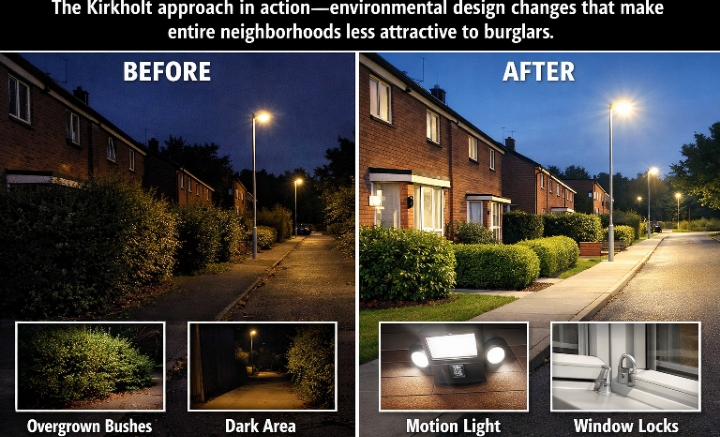
The key insight: burglars return to familiar territory. Once they know a neighborhood’s layout and vulnerabilities, they exploit that knowledge repeatedly. The Kirkholt project disrupted this by changing the environment—improving lighting, securing vulnerable entry points, and creating community awareness that made the entire area less attractive.
I applied these principles to my own neighborhood by organizing quarterly security audits. We walk the block together, identifying overgrown hedges, poor lighting, and vulnerable windows. The collective improvement has made our street notably safer—burglars prefer areas where they can predict vulnerabilities, not communities that actively adapt.
2026 Trends: What’s Changing in Burglary and Prevention
The Decline of Traditional Burglary
Property crime has plummeted to its lowest level in at least 48 years, with residential burglaries down 45% compared to 2019 pre-pandemic levels in many cities. This decline reflects better policing, community efforts, and widespread security adoption. However, the remaining burglars are more sophisticated, targeting specific vulnerabilities rather than random opportunities.
| Year | Residential Burglary Trend | Key Factor |
|---|---|---|
| 2019 | Baseline | Pre-pandemic normal |
| 2020-2021 | -16% | More people home during pandemic |
| 2022-2023 | -25% | Security system adoption increases |
| 2024 | -8.6% | Continued decline [^5^] |
| 2025 (H1) | -19% | AI security technology普及 [^1^] |
| 2026 (Projected) | Stable/Low | Smart home integration complete |
The Rise of Package Theft and Porch Piracy
While traditional burglaries decline, package theft remains persistent. An estimated 104 million packages were stolen in 2025, down from 120 million in 2024 but still representing $15 billion in consumer losses. One in four Americans has experienced package theft at least once.
Burglars have adapted their target selection to include high-value deliveries. They follow delivery trucks, watch for Amazon boxes left on porches, and strike within minutes of drop-off. The psychology is identical to home burglary—opportunity assessment, quick execution, minimal risk—but the timeline is compressed to minutes rather than hours.
My solution combines technology and routine: daily security habits include checking delivery notifications immediately, using a secure package locker for high-value items, and installing a video doorbell with package detection. When a delivery arrives, I receive an alert; if I’m not home, I can speak to the driver through the doorbell or ask a neighbor to retrieve it.
AI and the Future of Prevention
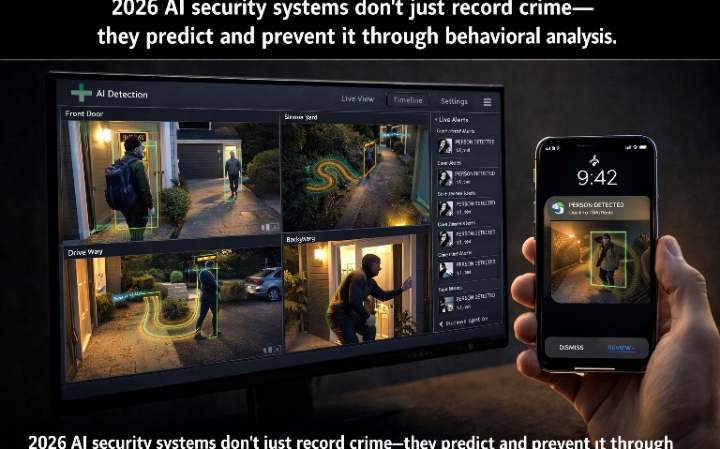
The 2026 burglar fears integrated smart ecosystems. Video verification, AI behavioral analysis, and automated response systems have made random targeting too risky. Modern systems don’t just detect motion—they analyze behavior patterns, recognize faces, and escalate deterrence automatically.
Samsung’s EdgeAware AI Home, showcased at CES 2026, can analyze sounds and activity throughout the home, detecting breaking glass, running water, or unusual movement patterns. This technology shifts security from reactive to predictive, identifying threats before they materialize into break-ins.
For my setup, I’ve integrated AI cameras with smart lighting and automated alerts. When the system detects a person approaching after dark, it triggers a sequence: lights activate, cameras begin recording and tracking, and I receive a live feed on my phone. The burglar knows they’ve been seen before they even reach the door.
Pros and Cons: Security Strategies Compared
| Strategy | Pros | Cons | Best For |
|---|---|---|---|
| Traditional Alarm Systems | Proven deterrent, professional monitoring, insurance discounts | Monthly fees, false alarms, delayed response | Homeowners wanting hands-off protection |
| DIY Smart Security | Lower cost, customizable, no contracts | Self-monitoring burden, technical setup required | Tech-savvy homeowners |
| AI-Powered Cameras | Intelligent detection, fewer false alerts, predictive capabilities | Higher upfront cost, privacy concerns, subscription fees | High-traffic areas, package protection |
| Physical Hardening | No ongoing costs, permanent protection, works without power | Upfront installation, aesthetic impact, doesn’t deter all burglars | All entry points, budget-conscious homeowners |
| Neighborhood Watch | Community building, free, covers blind spots | Requires participation, inconsistent coverage, no tech integration | Tight-knit communities |
Conclusion: Making Your Home Invisible to Burglars
Understanding how burglars choose their targets has transformed my approach to home security. I no longer see it as a fortress to defend, but as a profile to manage. Every choice I make—from landscaping to social media posts to lighting schedules—contributes to a narrative that either attracts or repels criminal attention.
The data is clear: homes without security systems are 300% more likely to be targeted. But beyond technology, the daily habits I’ve developed matter just as much. I vary my routines, maintain my property, secure my digital footprint, and stay connected with neighbors. These practices cost little but provide enormous psychological deterrence.
In 2026, the advantage is shifting to homeowners. AI security, smart automation, and community awareness have made opportunistic burglary increasingly difficult. The burglars who remain in operation are more selective, targeting only those homes that clearly signal vulnerability.
Don’t be that signal. Implement the layers I’ve described: visible security, unpredictable routines, physical hardening, and smart technology. Make your home the one that burglars see and immediately dismiss as too risky, too complicated, too uncertain.
Your home should be your sanctuary, not a statistic. With the right knowledge and tools, you can ensure that when burglars choose their targets, your house never makes the list.
Ready to Secure Your Home?
Don’t wait for a break-in to take action. Start with these proven security solutions that I personally recommend and use in my own home.
Daily Security Habits
Learn the 10 daily routines that keep intruders away. Simple changes that make a huge difference.
Smart Door Locks
Upgrade your entry points with the best smart locks of 2026. Keyless entry, access logs, and remote control.
Outdoor Cameras
Stop intruders before they reach your door with AI-powered outdoor security cameras.

Borni Franklin is the founder of LotsHomeGuide and a home security researcher with over 5 years of experience studying real-world burglary patterns, property vulnerabilities, and practical protection strategies. He has tested home security products, analyzed how intruders select targets, and built free tools to help everyday homeowners assess and improve their safety. Every article on LotsHomeGuide is written from hands-on research — not recycled generic advice. Based in the USA. Read full information about Borni Franklin on our About Us page.
Join the Conversation
Have you ever noticed suspicious activity in your neighborhood? Share your experience in the comments below—your story might help someone else recognize the warning signs.
Questions to spark discussion:
I would love to read every comment and respond to questions. Let’s build a community of security-conscious homeowners helping each other stay safe!