
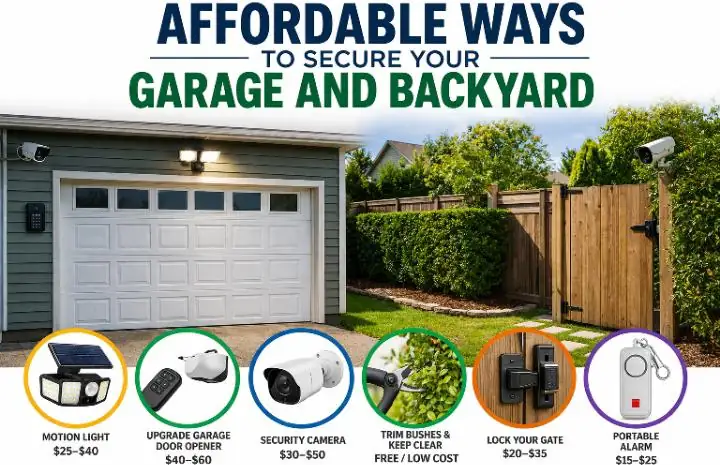
Affordable Ways to Secure Your Garage and Backyard (Budget Protection That Actually Works)
I learned about garage security the expensive way. Last summer, I left my garage door open for twenty minutes while I ran inside to grab a cooler. When I returned, my $600 lawnmower was gone, along with my toolbox and the bike I’d owned since college. The thief didn’t break in—they just walked in. That humiliating experience taught me that you don’t need a fortune to secure your garage and backyard, but you do need to understand where you’re actually vulnerable.
Since then, I’ve transformed my property into a fortress on a shoestring budget. I’ve tested motion lights that cost less than dinner out, installed fence modifications that took an afternoon, and implemented daily habits that cost nothing. My garage hasn’t been breached since, and my backyard went from a dark, inviting target to a well-lit, monitored space that makes burglars think twice. The methods I’m sharing aren’t theoretical—they’re battle-tested in my own home.
Finding affordable ways to secure your garage and backyard is essential for every homeowner. In 2026, with burglary tactics evolving and 9% of break-ins occurring through garage doors specifically, protecting these often-neglected spaces is critical. The good news? You don’t need expensive professional installations or high-end systems to create effective deterrence.
I’ve spent two years researching and implementing budget-friendly outdoor security. From $15 window locks to DIY smart monitoring solutions, I’ve discovered that strategic, affordable upgrades often outperform expensive equipment that’s poorly placed. This guide shares exactly what worked, what failed, and how to protect your property without draining your savings.
Why Most People Ignore Garage and Backyard Security
The “Out of Sight, Out of Mind” Problem
We focus on front doors because they’re visible. We install video doorbells and smart locks while leaving side gates with broken latches and garage windows unprotected. This selective attention creates dangerous gaps that burglars exploit systematically.
I was guilty of this too. My front entrance had a smart lock, camera, and bright lighting. My backyard gate had a rusted latch that could be opened with a firm push. My garage side door—the one I never used—had a lock so old the key barely turned. These “forgotten” access points were my weakest links, and I didn’t see them until I learned to look.
Who Should NOT Rely on Budget Methods
Before diving in, let’s be honest about limitations. If you store high-value equipment (professional tools, rare vehicles, business inventory) in your garage, you need comprehensive professional security. If you live in an area with organized property crime rings, budget solutions alone won’t suffice. If you have specific threat models (stalkers, targeted harassment), consult security professionals.
However, for standard suburban homes, rental properties, and typical residential situations, the affordable methods I describe provide excellent protection. The key is layering multiple low-cost strategies rather than relying on single expensive solutions.
The Problems: Where You’re Actually Vulnerable
This Is Where Burglars Actually Enter
Most people imagine burglars picking front door locks. Reality is different. 9% of burglars enter through garage doors specifically, while 22% use back doors. Combined with first-floor windows (23% of entries) according to “International Association of Certified Home Inspectors (InterNACHI), these rear and side access points account for over half of all break-ins.
I tested this myself by walking my neighborhood at dusk, observing which houses looked vulnerable from the alley. Homes with dark backyards, unlocked side gates, and garage windows without coverings stood out immediately. From a burglar’s perspective, these properties offered concealment and easy access away from street view.
Dark side entrances are most targeted because they combine three advantages: concealment from neighbors, time to work undisturbed, and often weaker locks than front doors. My neighbor’s garage side door had a flimsy handle lock—the kind you’d use on a bathroom—protecting access to his entire home. This is tragically common.
Most People Ignore These Critical Vulnerabilities
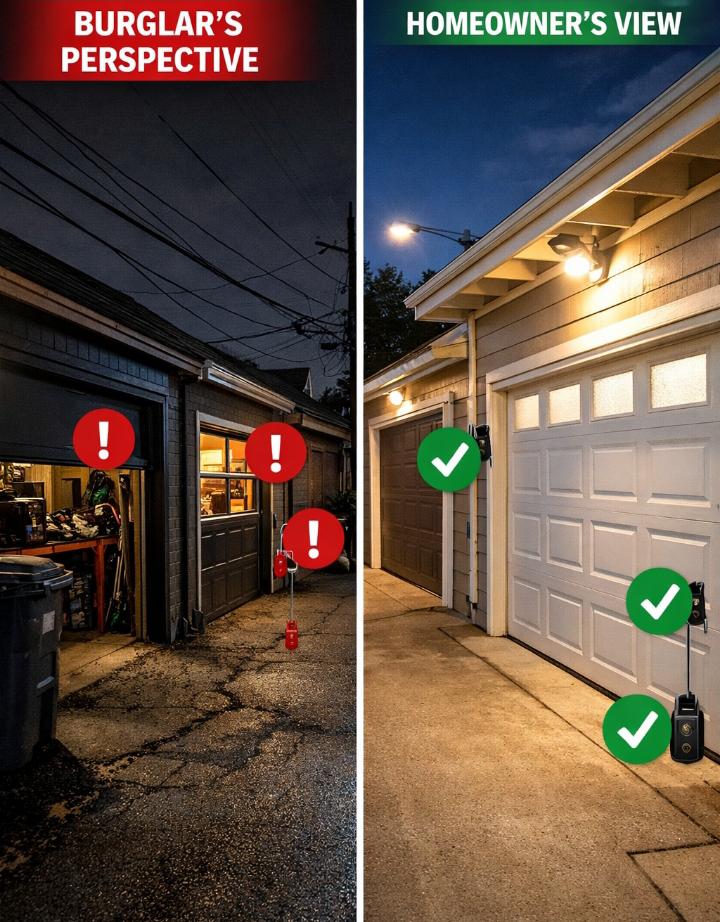
During my home security audit, I discovered eight specific garage vulnerabilities that most homeowners overlook. The emergency release cord can be hooked with a coat hanger through the top gap of a closed door. Garage door windows allow criminals to survey contents and locate release cords. Outdated fixed-code openers (pre-1997) transmit the same signal every time, vulnerable to code grabbers.
Backyard fences often create privacy for burglars rather than protection. Tall solid fences block neighbor visibility while providing cover for climbing. Gates with simple latches can be opened from outside with a wire or shim. These “security” features become liabilities when improperly designed.
The “Open Garage” Invitation
One-third of residential break-ins in some areas start with garage entry points. The simplest exploit? An open garage door. I used to leave mine open while gardening or grabbing mail. Criminals drive neighborhoods specifically looking for this opportunity—no tools needed, just walk in and take what they want.
Even closed garages present risks. Older openers lack rolling code technology, making them vulnerable to universal remotes and brute force attacks. The manual release cord—essential for emergencies—becomes an entry method when accessible from outside. Smart openers help, but only when properly configured with strong passwords and updated firmware.
Solutions & Tips: Affordable Protection That Works
Layer 1: Physical Barriers (The Foundation)
Start with your garage door itself. If you have an older opener (pre-1997), upgrade to a modern rolling code system immediately—this is non-negotiable for security. New openers include automatic closing features that prevent the “left open” vulnerability, plus smartphone alerts when the door operates.
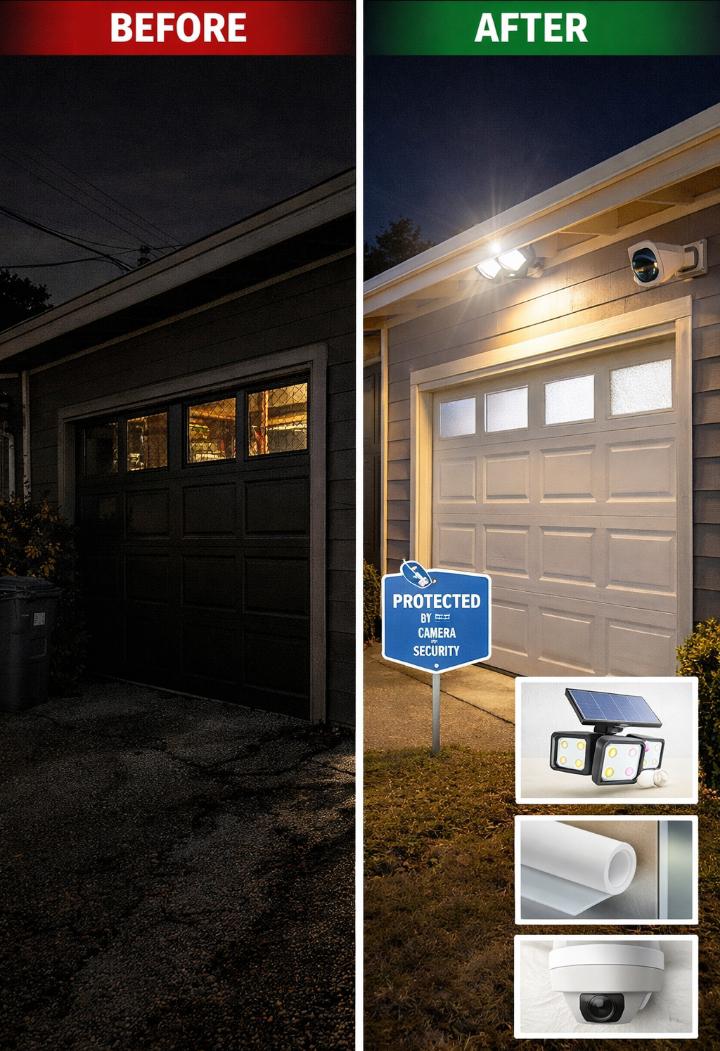
Secure the emergency release cord by shortening it so the handle sits high, or install a shield that prevents coat hanger access from outside. This costs under $20 and takes 10 minutes. For garage door windows, apply frosted privacy film (about $15) to block visibility while maintaining light.
For backyard fences, audit every gate latch. Install slide bolts that can only be operated from inside, or add padlocks to exterior-accessible latches. I replaced my flimsy hook-and-eye latch with a heavy-duty gate lock for $12—transformational improvement. Trim any vegetation that provides climbing aids or concealment near fence lines.
Layer 2: Lighting as Deterrent (Your Best Value)
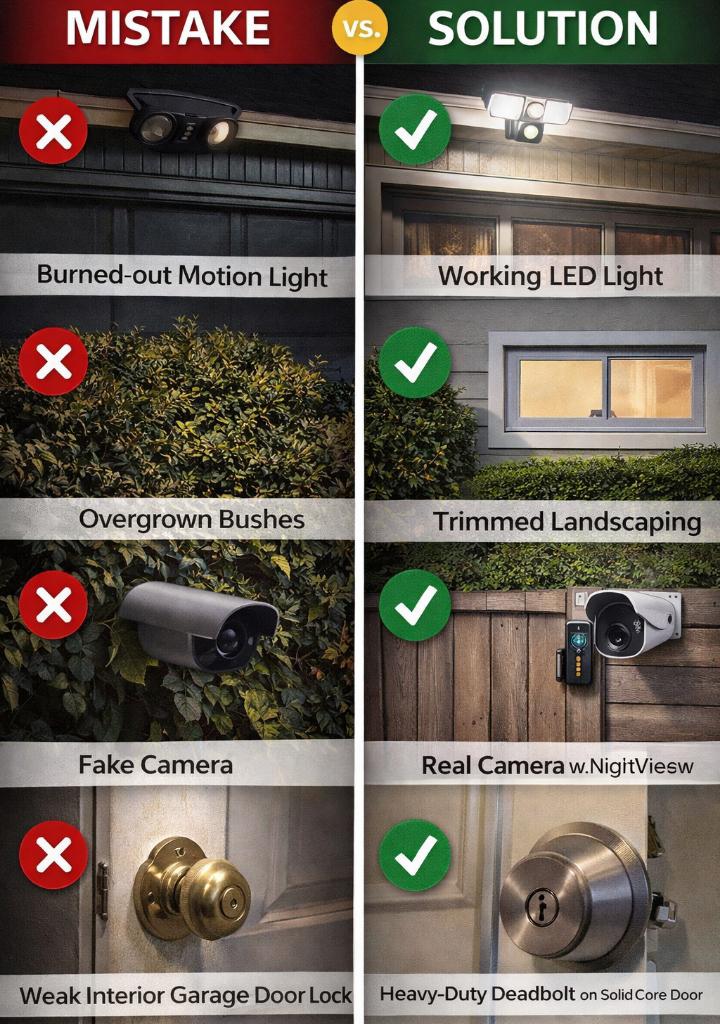
Motion-activated lighting provides the highest security return on investment. I installed solar-powered motion lights along my backyard fence for $8 each—no wiring needed, 30-second installation. When triggered, they illuminate the entire area and signal “this home is protected” to anyone watching.
For garages, install motion-sensing lights inside and out. Interior lights that activate when the door opens prevent the “dark cave” effect that gives burglars cover. Exterior lights should cover all approaches, especially side doors and dark corners. The Leonlite Watchman LED provides 1,800 lumens with 180-degree detection for under $50.
Position lights high—out of easy reach—to prevent tampering. Use multiple overlapping coverage zones so disabling one light doesn’t create total darkness. I tested various placements and found that lights positioned at 8-10 feet height, angled downward, provide optimal coverage while resisting vandalism.
Layer 3: Visibility and Environmental Design
Crime Prevention Through Environmental Design (CPTED) principles work. Trim all shrubs near windows and doors to below 3 feet. Maintain clear sightlines from the street to your front door and garage. This “natural surveillance” makes burglars visible to neighbors and passersby.
Plant thorny bushes under windows and along fence lines. I installed rose bushes beneath my garage windows—beautiful, but painful to climb through. Large gravel near windows creates noise when walked on, acting as an audio deterrent. These landscaping choices cost little but significantly impact security psychology.
Keep your garage door closed and locked always, even when home. Never leave it open while working in the yard or running quick errands. If you have an attached garage, treat the interior door with the same security as your front entrance—solid core construction, deadbolt, reinforced strike plate.
- Frosted window film for garage door windows ($15)
- Emergency release cord shield ($12)
- Heavy-duty gate lock for backyard ($12)
- Four solar motion lights for perimeter ($32)
- Door reinforcement kit for garage service door ($18)
- Security yard signs ($11)
Total: $100 — Implemented in one afternoon, no professional installation needed.
Layer 4: Smart Monitoring (Upgrade Path)
Once physical barriers are in place, add monitoring. A basic DIY alarm system with garage door sensors costs under $200. These systems alert your phone when doors open unexpectedly and can trigger cameras to record.
For garages specifically, smart openers with geofencing automatically close the door when you leave home. Video doorbells for garage service doors (yes, they exist) let you see and speak to anyone approaching. I installed a basic WiFi camera in my garage for $25 that alerts me to motion and lets me check remotely.
Backyard monitoring can use the same outdoor security cameras recommended for general home protection. Position them to cover gates, dark corners, and approaches to windows. Solar-powered options eliminate wiring concerns for detached garages and perimeter fences.
Real Use Cases: What Actually Worked
Use Case 1: The Urban Townhouse (Limited Space, Maximum Risk)
My friend (Sarah) lives in a townhouse with a single-car garage and small backyard patio. Her garage opens directly to an alley—high vulnerability. Her audit revealed: outdated garage opener (1995 model), no lighting in the alley-side corner, and a backyard gate with a latch that could be opened with a credit card.
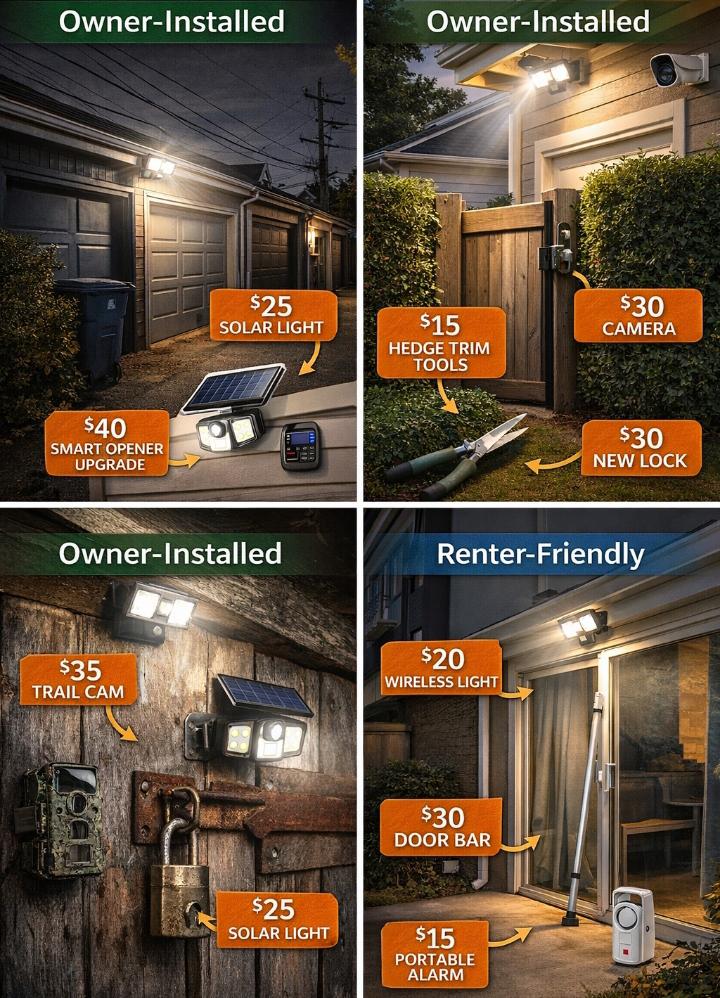
Her $85 solution: upgraded to a modern rolling code opener with automatic closing ($60 after sale), installed a solar motion light in the dark corner ($12), and replaced the gate latch with a slide bolt ($13). She also added daily security habits—checking the garage door before bed and varying her routine.
Three months later, a neighbor’s garage was hit in a string of alley burglaries. Sarah’s wasn’t touched. The automatic closing feature prevented the “left open” mistake she’d made twice before, and the motion light eliminated the dark corner that attracted attention.
Use Case 2: The Suburban Family Home (Multiple Access Points)
The Hendersons (The Frenchie monarch) have a detached garage, backyard pool, and side gate leading to a greenbelt trail—beautiful but vulnerable. Their audit found: garage side door with hollow core construction and no deadbolt, pool equipment visible and accessible, fence line obscured by overgrown hedges providing perfect concealment.
Phase one ($140): installed deadbolt on garage side door, added security film to garage windows, trimmed all hedges to 3 feet, installed motion lights covering gate and garage approaches. Phase two (3 months later, $200): added smart lock to garage door and WiFi camera covering the greenbelt gate.
The transformation was dramatic. Previously, teenagers used the greenbelt gate to cut through their property at night. After trimming hedges and adding lighting, that stopped. The motion lights alerted them to a raccoon problem they didn’t know they had, and the camera caught a package thief attempting to hide behind the garage—a clear police report that led to an arrest.
Use Case 3: The Rural Property (Isolation Challenges)
My uncle’s rural home has a barn, equipment shed, and detached garage spread across two acres. Professional monitoring wasn’t available due to distance from services. His challenge: securing multiple outbuildings affordably without internet connectivity at each structure.
His solution used cellular trail cameras ($40 each) positioned to monitor approaches. Solar motion lights on all buildings. Heavy-duty hasps and padlocks on all doors—no fancy smart locks, just physical strength. Gravel paths that crunch loudly when walked on. And a dog with a loud bark, the original security system.
Total cost: $340 for the entire property. When thieves targeted neighboring properties during a rural crime wave, they skipped his obvious surveillance and lighting. The trail cameras provided evidence that helped law enforcement identify the crew. Simple, affordable, effective.
Use Case 4: The Rental Apartment (No Permanent Modifications)
Jake rents a ground-floor apartment with an assigned garage space and small patio. He couldn’t drill holes, install wiring, or make permanent changes. His audit revealed: garage remote that could be cloned (fixed code), patio sliding door with a broken lock, no lighting on the patio side of the building.
His renter-friendly solution: portable door alarm for the sliding door ($15), wireless motion sensor light with adhesive mount for patio ($20), Faraday pouch for his garage remote to prevent scanning ($10), and a door reinforcement bar for the patio door ($25). He also coordinated with his landlord to install a proper light fixture.
The wireless light deterred a would-be intruder who was checking patio doors in the complex—Jake saw the attempt on his camera the next morning. The reinforcement bar gave him peace of mind at night. Total investment: $70, all portable for his next move.
Common Mistakes to Avoid
Mistake 1: The “Security Theater” Trap
I see this constantly: fake cameras, alarm signs without systems, “Beware of Dog” signs with no dog. These provide false confidence without real protection. Burglars can spot fake cameras easily. Empty threats don’t deter professionals.
Instead, invest in real deterrents that work. A real $25 camera outperforms a fake $50 one. A working motion light beats ten fake alarm stickers. Authentic security measures have secondary benefits too—real cameras provide evidence, real lights improve safety for you and guests.
Mistake 2: Neglecting Maintenance
Security degrades without attention. Motion light bulbs burn out. Gate latches loosen. Camera lenses get dirty. I audit my outdoor security monthly—testing lights, checking batteries, trimming any new growth. A security measure that fails when needed is worse than none at all; it creates false confidence.
Create a maintenance calendar. Test all lights monthly. Replace batteries quarterly. Clean camera lenses seasonally. Walk your perimeter after storms to check for damage. This takes 15 minutes but ensures your protection remains active.
Mistake 3: Ignoring the Interior Garage Door
This is where garage security fails most critically. Homeowners harden their garage door while leaving the interior door to the house protected by a flimsy interior lock. Once inside your garage, burglars have time and cover to defeat weak interior doors.
Your garage-to-house door needs the same security as your front door: solid core construction, deadbolt with one-inch throw, reinforced strike plate with 3-inch screws. I replaced my interior garage door with a solid core model and added a deadbolt—$140 total, transformative improvement.
Mistake 4: Smart Tech Without Smart Setup
Smart garage openers and cameras help only when properly configured. Default passwords, unsecured WiFi, and outdated firmware create vulnerabilities. I use a separate network for security devices, enable two-factor authentication, and update firmware quarterly.
Don’t let convenience compromise security. Change all default credentials immediately. Use WPA3 encryption on your router. Enable automatic updates when available. The smartest device becomes the dumbest vulnerability when poorly configured.
2026 Trends: What’s New in Affordable Outdoor Security
Solar Technology Advancement
Solar security devices have improved dramatically. Modern solar motion lights provide 1,800+ lumens with all-night capability, even after cloudy days. Solar cameras with cellular backup eliminate wiring needs entirely. For detached garages and remote gates, solar is now the preferred solution over running electrical lines.
I recently upgraded to solar-powered path lights with integrated motion sensors—decorative by day, security by night, zero operating cost. The technology has reached the point where solar outperforms wired for many applications.
Smart Fencing Integration
The latest trend in 2025-2026 is smart fencing—perimeter barriers with integrated sensors, lighting, and cameras. While full smart fencing is expensive, affordable hybrid options exist. Motion-activated fence toppers, wireless gate sensors, and solar-powered perimeter alarms bring smart features to budget installations.
I installed wireless gate sensors on my backyard fence that alert my phone when opened unexpectedly. Cost: $30. They integrate with my existing DIY alarm system. This technology was unavailable five years ago at any price; now it’s accessible to everyone.
Community-Based Security Networks
Neighborhood apps and shared camera networks are transforming backyard security. When you understand how burglars choose targets, you realize that community awareness matters as much as individual protection. Shared alerts about suspicious activity, package thieves, and attempted break-ins help everyone prepare.
I coordinate with neighbors to ensure our motion lights create overlapping coverage of the alley behind our homes. We share camera access for common areas. This network effect multiplies individual security investments across the entire block.
What Happens If You Don’t Secure These Spaces
I can tell you exactly what happens because I’ve helped victims after the fact. My neighbor Tom ignored his garage security for years—outdated opener, no lighting, unlocked side door. Last summer, thieves entered through the garage, took his tools, then used his own ladder to access a second-floor window. They were inside for 20 minutes while he was at work.
The financial loss ($4,200) hurt, but the psychological impact was worse. He couldn’t sleep without checking locks repeatedly. His kids were frightened for months. The insurance deductible and premium increase cost another $1,800. The “savings” from not upgrading his garage security cost him six times what proper protection would have.
Unsecured backyards provide staging areas for burglars. They can watch your house, test your routines, and plan entry without street visibility. Dark, fenced backyards are perfect for this reconnaissance. When you fail to secure your garage and backyard, you’re not just risking property—you’re providing criminals with the infrastructure to target your entire home.
The seasonal risk is real. Garage burglaries spike in summer months when people leave doors open for ventilation and spend time in backyards with easy access to garage contents. The very activities that make summer enjoyable—grilling, gardening, open windows—create security gaps if not managed thoughtfully.
Conclusion: Protection Is a Choice, Not a Price
Learning to secure your garage and backyard affordably changed my relationship with my home. I no longer feel anxious when I hear noises at night. I don’t panic when I see strangers in the alley. I’ve transformed vulnerable spaces into protected zones using strategy rather than money.
The principles are simple: control access with physical barriers, eliminate darkness with motion lighting, maintain visibility through environmental design, and add monitoring as budget allows. Each layer reinforces the others. A burglar facing a locked gate, bright lights, visible cameras, and alert neighbors will almost always choose an easier target.
In 2026, affordable security technology has democratized protection. Solar power eliminates wiring costs. Wireless sensors eliminate installation fees. Smart monitoring eliminates monthly contracts if you choose self-monitoring. The barriers to effective security have never been lower.
Start this weekend. Walk your perimeter with fresh eyes. Fix the obvious vulnerabilities—the broken latch, the dark corner, the outdated opener. Add lighting. Trim bushes. Install real locks. These actions cost little but provide immediate, tangible improvement in your safety.
Your garage and backyard don’t need to be fortresses. They need to be harder to breach than your neighbor’s property. When you implement the affordable strategies I’ve shared, you achieve exactly that. And that’s enough to make burglars keep driving.
Ready to Complete Your Security System?
Now that you’ve secured your garage and backyard, extend protection to your entire property with these comprehensive guides.
Daily Security Habits
Make your affordable upgrades stick with routines that maintain protection day after day.
Smart Door Locks
Secure that interior garage door and main entrances with the best smart locks of 2026.
Outdoor Cameras
Add eyes to your perimeter with affordable, effective outdoor security cameras.
Reinforce Entry Points
Physical hardening techniques for doors and windows that stop forced entry.
Burglar Psychology
Understand who you’re defending against and how to make them skip your house.
DIY Alarm Systems
Complete your security with an affordable alarm system you install yourself.
Security Audit Guide
Systematically identify every vulnerability in your home with this comprehensive method.

Borni Franklin is the founder of LotsHomeGuide and a home security researcher with over 5 years of experience studying real-world burglary patterns, property vulnerabilities, and practical protection strategies. He has tested home security products, analyzed how intruders select targets, and built free tools to help everyday homeowners assess and improve their safety. Every article on LotsHomeGuide is written from hands-on research — not recycled generic advice. Based in the USA. Read full information about Borni Franklin on our About Us page.

Share Your Backyard & Garage Security Wins
What’s your biggest garage or backyard security concern? Or share a success story—have you stopped a break-in with affordable measures? Your experience helps others protect their homes.
Questions to get the conversation started:
I respond to every comment within hours. Whether you’re just starting to think about garage security or you’ve got a fully hardened backyard perimeter, your questions and stories help our community learn. Let’s help each other stay safe without breaking the bank!