
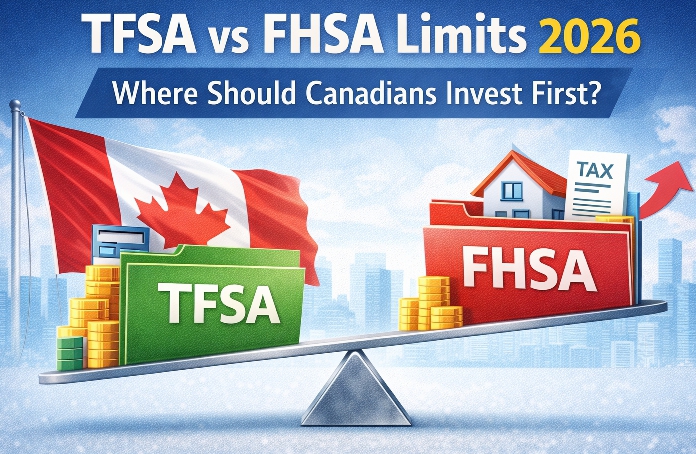

TFSA vs FHSA Limits 2026: Where Should Canadians Invest First?
The question many Canadians are quietly Googling right now is simple but important: TFSA vs FHSA limits 2026 — where should I invest first? With rising housing prices, higher interest rates, and tighter budgets, choosing the right registered account can make a real difference to your future.
This guide breaks down everything you need to know about TFSA vs FHSA limits 2026, the FHSA contribution limit, real-life examples, and smart strategies — without complicated jargon or boring textbook explanations. Think of this as a friendly financial chat over coffee, not a lecture.
Quick Overview: TFSA vs FHSA (2026 Snapshot)
Before we go deep, here’s a plain-English summary to set the stage. Both accounts are powerful — but they serve very different goals.
- TFSA (Tax-Free Savings Account): Flexible, long-term wealth building, withdrawals anytime.
- FHSA (First Home Savings Account): Designed specifically for buying your first home.
The challenge in 2026 isn’t choosing one — it’s deciding which comes first based on your situation.
What Is a TFSA? (And Why Canadians Love It)
A Tax-Free Savings Account (TFSA) is Canada’s most flexible investment account. Despite the name, it’s not just for “saving.” You can invest in stocks, ETFs, bonds, GICs, and more — and keep 100% of your gains tax-free.
In 2026, the TFSA remains one of the best tools for building long-term wealth while staying flexible. You can withdraw money anytime without penalties, which makes it ideal for emergencies or opportunities.
TFSA Key Benefits
- Tax-free growth and withdrawals
- No income restrictions
- Withdraw anytime, re-contribute later
- Great for investing, not just saving
For Canadians concerned about taxes — especially after recent discussions around Canada capital gains changes — the TFSA feels like a safe haven.
What Is an FHSA? (Canada’s New Home-Buyer Weapon)
The First Home Savings Account (FHSA) is Canada’s newest registered account, created to help first-time buyers save for a down payment faster — and smarter.
Here’s the magic: contributions are tax-deductible (like an RRSP), and withdrawals for a qualifying home purchase are tax-free (like a TFSA). It’s the best of both worlds.
FHSA Contribution Limit (2026)
- Annual contribution limit: $8,000
- Lifetime contribution limit: $40,000
That means in 2026, understanding the FHSA contribution limit is critical. If you delay opening one, you may lose valuable contribution room forever.
Screenshot suggestion: Add a CRA FHSA contribution limit chart here to visually show annual vs lifetime caps.
TFSA vs FHSA Limits 2026: Side-by-Side Comparison
Let’s put the numbers and features next to each other so the differences are crystal clear.
| Feature | TFSA | FHSA |
|---|---|---|
| Annual Limit (2026) | Government-set (indexed) | $8,000 |
| Lifetime Limit | Cumulative since age 18 | $40,000 |
| Tax Deduction | No | Yes |
| Tax-Free Withdrawal | Yes | Yes (for home purchase) |
So… TFSA or FHSA First in 2026?
Here’s the honest answer: it depends on your timeline. Let’s walk through real-life scenarios Canadians actually face.
Scenario 1: You Plan to Buy a Home in 3–7 Years
If home ownership is realistic in the next decade, prioritizing the FHSA makes sense. The FHSA contribution limit gives you tax deductions now and tax-free withdrawals later — a rare combo.
Once FHSA room is maxed, you can still grow extra savings in a TFSA without penalties.
Scenario 2: You’re Unsure About Buying a Home
If you’re undecided or renting long-term, the TFSA wins on flexibility. You’re not locked into one goal, and your money remains accessible for life events, investing, or emergencies.
Scenario 3: You’re Building Digital or Alternative Income
Many Canadians earning through online platforms, digital value systems, or flexible income streams prefer TFSA liquidity. This aligns well with modern financial tools like digital wallets and new ways value moves without banks.
Smart Strategy: Use Both (Without Stress)
Here’s a practical approach many financially savvy Canadians are using in 2026:
- Open FHSA early to lock in contribution room
- Contribute what you can annually (even small amounts)
- Use TFSA for flexibility, investing, and backup savings
This balanced strategy protects you from policy changes while giving you optionality — something that’s becoming increasingly valuable as financial systems evolve.
For example, understanding how value moves without traditional banks can help you diversify your thinking around money, not just where you store it.
Common Mistakes Canadians Make
- Waiting too long to open an FHSA
- Using FHSA funds for non-qualifying purchases
- Ignoring TFSA growth potential
- Overcomplicating simple decisions
Financial progress doesn’t require perfection — just consistency and clarity.
Final Verdict: TFSA vs FHSA Limits 2026
The debate around TFSA vs FHSA limits 2026 isn’t about which account is better — it’s about which account fits your life right now.
If buying a home is on your radar, the FHSA contribution limit makes it a powerful first move. If flexibility matters more, the TFSA remains king. And for many Canadians, using both is the smartest answer.
The most important step? Start. Even small contributions today can quietly change your financial future.
Related Topics
- How Digital Value Moves Without Traditional Banks
- Why Financial Access Is Replacing Bank Accounts
- What Makes a Digital Wallet Truly Secure
- Prepaid Digital Value vs Bank Money
- Bonds vs Cash in 2026