How to Use Your Burglary Risk Score to Build a Home Security Plan
Getting your home burglary risk score is step one. But a number without a plan attached to it is just anxiety with extra steps. I have watched too many homeowners check their score, feel worried for three or four days, and then do absolutely nothing meaningful about it.
I built my own complete home security plan directly from my burglary risk score results and it transformed how I think about protecting my property on a daily basis. This guide walks you through the exact process I used so you can turn your score into real, lasting security without wasting money on the wrong things.
Why Most Home Security Plans Fail Before They Even Start
Most people approach home security completely backwards. They see an advertisement for a doorbell camera, or they hear about a neighbor being burgled, and they reactively buy whatever product is most prominent in their mind at that moment. That approach is expensive, inefficient, and often addresses the wrong vulnerabilities entirely for their specific property.
A home burglary risk score fixes this fundamental problem by telling you exactly where your specific vulnerabilities are and ranking them by severity. Instead of guessing what to fix, you have a prioritized map of your actual property weaknesses. That map becomes the non-negotiable foundation of every effective home security plan.
Step 1: Get Your Baseline Burglary Risk Score Before Spending Anything
Before you spend a single dollar on any security product whatsoever, you need your actual assessed score. I ran mine using the LotsHomeGuide home burglary risk score tool which takes approximately five minutes to complete and generates a specific breakdown of every factor that is contributing to your result.
Write down your score and either print or screenshot the full breakdown report. This document is your security baseline and it is the reference point you will return to every single time you make an improvement and every time you conduct a retest. Without a clearly documented baseline number, you have no objective way to measure whether your fixes are actually working.
- Record your exact burglary risk score number and the date you ran it
- Screenshot or print the complete vulnerability breakdown
- Note which single category contributes most to your score
- Set a specific target score you want to achieve within 30 days
- Set a calendar reminder right now to retest exactly 30 days from today
Step 2: Categorize Your Vulnerabilities Into Four Clear Groups
When I received my score breakdown, my first action was organizing every vulnerability into one of four distinct categories before deciding on a single fix. This categorization step transformed a potentially overwhelming list into a structured and genuinely actionable plan.
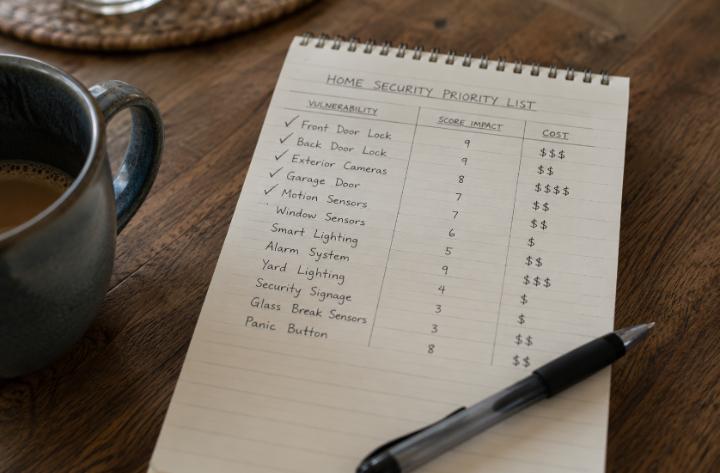
Step 3: Prioritize by Score Impact Per Dollar, Not by Lowest Cost
The most consistent mistake I observe homeowners making when building a security plan is fixing the cheapest items first because it feels productive and achievable. That approach often misses the most significant vulnerabilities entirely while creating a false sense of having taken meaningful action.
I learned to prioritize by score impact per dollar spent instead. For example, reinforcing my back door frame cost $60 and dropped my burglary risk score by 18 points. Adding a second camera cost $89 and dropped my score by only 8 points. The framework makes these investment decisions completely obvious once you have the assessment data in front of you.
Step 4: Build Your 30-60-90 Day Phased Security Plan
I broke my complete home security plan into three distinct monthly phases. This structured approach prevents the overwhelm that causes most people to quit before finishing, and it ensures the most critical and highest-impact fixes always happen in the first phase before anything else.
- Reinforce all exterior door frames with steel strike plates and 3-inch screws – full reinforcement guide
- Install Grade 1 deadbolts on both front and back exterior doors
- Test and fix all ground floor window latches and add security pins
- Secure any side gate with a padlock or heavy barrel bolt
- Add anti-lift pins or a track bar to any sliding glass doors
- Install motion sensor lights on every dark exterior wall – top picks here
- Reposition or add outdoor cameras for complete approach coverage – best cameras 2026
- Install a functioning alarm system on all ground entry points – DIY alarm guide
- Upgrade exterior locks to smart lock grade – best smart locks 2026
- Install a doorbell camera with two-way audio – doorbell install guide
- Configure smart plugs with randomized and varied light schedules
- Trim all hedges and ornamental shrubs below three feet near entry points
- Remove any climbable objects stored against perimeter fence panels
- Set up a mail and package collection plan for all future travel
- Review all social media privacy settings and future posting habits
Step 5: Assign a Realistic Budget to Each Phase
One of the most common reasons homeowners stall completely on their security plan is seeing the total estimated investment and freezing up. The three-phase structure solves this problem directly by spreading the total cost across three separate months. Here is a realistic budget breakdown based entirely on my own documented experience.
Step 6: Retest Your Burglary Risk Score After Every Phase
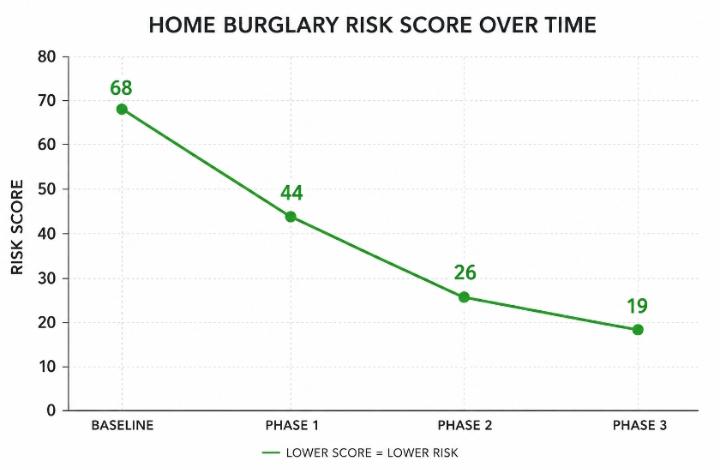
After completing each phase of my plan, I immediately re-ran my home burglary risk score assessment. This retesting step is critical and non-negotiable because it confirms your fixes are actually registering as improvements, shows your measurable documented progress, and reveals any remaining vulnerabilities you may have missed or underestimated in the initial assessment.
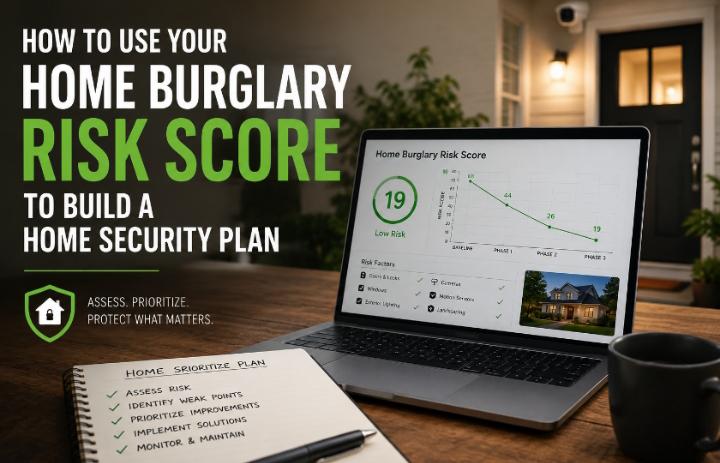
After completing Phase 1, my score dropped from 68 to 44. After Phase 2 was complete, I was sitting at 26. After finishing all of Phase 3, my score settled at 19 which is in the very low risk category. I have maintained that score for eight consecutive months through my quarterly retest habit. Retesting turns your one-time security plan into an ongoing living system rather than a forgotten project.
Special Consideration: Building a Security Plan for an Apartment
The 30-60-90 phased plan works effectively for houses but apartment residents face meaningfully different constraints. There is no private perimeter to control, entry points are shared with other residents, and landlord restrictions limit what physical modifications you can make to the unit itself.
For apartment residents I put together a separate dedicated resource: the complete apartment security guide for 2026. The core principle of scoring your vulnerabilities first and prioritizing by impact remains identical. Only the specific fixes change to reflect the apartment context and its unique constraints.
Four Clear Signs Your Home Security Plan Is Actually Working
A working security plan produces measurable and observable results. I tracked all four of the following indicators on my own property throughout the 90-day plan period. These are the benchmarks that tell you objectively whether your investment is translating into real-world deterrence.
- Your retest burglary risk score drops by at least 15 points after completing Phase 1 alone
- You have confirmed complete camera coverage of every approach route and entry point
- Every exterior entry point on your property has a Grade 1 lock or stronger installed
- Your entire property perimeter is illuminated on all sides after dark with no dark zones remaining
When you can confirm all four of these conditions are met simultaneously, your home is now measurably more difficult to burglarize than the average property in your surrounding neighborhood. That relative difficulty is the actual goal because burglars making target selections almost always choose the path of least resistance between comparable adjacent properties. My detailed guide on how burglars choose their targets explains exactly how this selection process works.
Get your free burglary risk score in under 5 minutes. It gives you the exact data you need to build a phased plan that works for your specific property and budget.
Conclusion
A home security plan built around your actual assessed burglary risk score is infinitely more effective than one built around guesswork or reactive purchases. The six-step process I have outlined in this guide works for any home at any budget level and produces measurable, objective improvements that you can verify through retesting.
I went from a burglary risk score of 68 all the way down to 19 in exactly 90 days for a total investment under $300. That result came from a structured system not from luck or expensive professional installation. Start with your free burglary risk score assessment, follow the three phases systematically, and retest your progress after each one. Your home will be measurably safer within 30 days of starting.
Where are you currently in the 30-60-90 plan? Did Phase 1 fixes drop your burglary risk score as much as you hoped and expected? Share your before and after score numbers in the comments below. Seeing real documented numbers from real homeowners going through this same process is genuinely the most motivating content I can offer on this page and it helps everyone who reads it next.

Borni Franklin is the founder of LotsHomeGuide and a home security researcher with over 5 years of experience studying real-world burglary patterns, property vulnerabilities, and practical protection strategies. He has tested home security products, analyzed how intruders select targets, and built free tools to help everyday homeowners assess and improve their safety. Every article on LotsHomeGuide is written from hands-on research — not recycled generic advice. Based in the USA. Read full information about Borni Franklin on our About Us page.