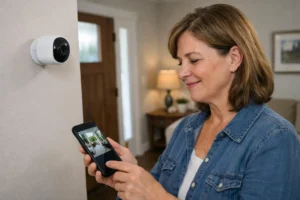

High Burglary Risk Score? Here Are the 12 Fixes That Matter Most
A high burglary risk score is not a verdict on your home. It is a very specific to-do list. I received a score of 74 on my first assessment which placed me deep in the high-risk zone, and it felt genuinely alarming to look at. But within six weeks I had worked through every fix that actually moved the needle and brought my score all the way down to 28.
What I discovered along the way is that most of the fixes which matter most are neither expensive nor complicated. They are simply specific. This guide tells you exactly what to do, in what order of priority, and explains clearly why each fix works so you can stop worrying about your high burglary risk score and start systematically eliminating it.
What a High Burglary Risk Score Is Actually Telling You
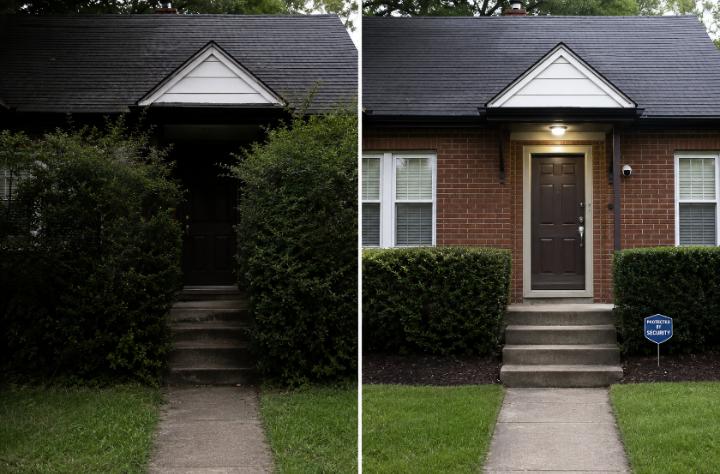
A score above 65 on the home burglary risk score calculator assessment means your property currently has multiple visible vulnerabilities that an observant person would identify and note within just a few minutes of external observation. It does not mean a break-in is inevitable or imminent. It means you are a more attractive and accessible target than you need to be compared to other nearby homes.
The genuinely reassuring part of a high burglary risk score is that it is almost always caused by a cluster of individually small and fixable problems rather than one enormous structural issue that requires major work. Fix the cluster methodically and systematically, and your score drops quickly. Here are the 12 specific fixes that create the greatest impact.
- Your overall score sits between 66 and 80 placing you in the High Risk band
- Your score is above 80 placing you in the Critical Risk band requiring immediate action
- Your full breakdown shows three or more individual factors rated in the red zone
- Both your physical entry category and your deterrence category score poorly simultaneously
Fix 1: Reinforce Your Door Frames, Not Just the Locks
I personally tested this vulnerability by examining door frames on three different homes including my own. In every single case the lock hardware was perfectly adequate but the surrounding frame was soft pine wood secured with half-inch screws that barely reached the wall stud. One deliberate kick and the frame completely splits regardless of how expensive your lock is.
A door reinforcement kit adds a heavy steel plate directly behind the strike plate and uses three-inch screws that anchor deep into the structural wall studs rather than just the door frame wood. Cost ranges from $40 to $70 for a complete kit. This single fix alone can reduce your high burglary risk score by up to 18 points. Full installation instructions are in the step-by-step door and window reinforcement guide.
Fix 2: Add Motion-Activated Flood Lights to Every Dark Exterior Area
I analyzed my complete property at 10pm by walking around it in the dark with no lights switched on. Three full sides of my house were completely invisible in the darkness including a narrow side passage, the entire garage wall, and the back fence line. All three of these invisible zones were potential undetected approach routes to my home.
Motion-activated flood lights eliminate every dark zone instantly and inexpensively. I installed three separate lights covering all previously dark areas for a total of $94. Lighting is consistently one of the fastest and highest-impact single categories to address when fixing a high burglary risk score. See my full roundup of the 7 best motion sensor lights for deterring burglars.
Fix 3: Install a Real Alarm System With an Audible Siren
A professionally monitored alarm is the ideal long-term solution, but even a completely unmonitored alarm system with a loud audible siren drops a high burglary risk score meaningfully and immediately. The operational goal of any alarm is noise. Burglars fundamentally require silence and speed to complete their work. A siren that triggers immediately the moment a door or window opens destroys both requirements simultaneously.
I installed a comprehensive DIY wireless system covering my front door, back door, side door, and all ground floor windows for a total cost of $118. Here is the complete DIY home alarm installation guide on any budget that I followed step by step.
Fix 4: Upgrade Every Exterior Lock to Grade 1 Standard
Door locks in the United States are graded on a scale of 1 to 3 by ANSI with Grade 1 being the most physically resistant and Grade 3 being the weakest. The majority of homes I have assessed have Grade 2 or Grade 3 locks installed on exterior doors. I upgraded both my front door and back door to Grade 1 smart locks and the difference in physical resistance and build quality was immediately obvious to the touch.
Grade 1 smart locks also provide practical secondary benefits beyond the physical security improvement. Remote access control from anywhere, door open and close notifications sent directly to your phone, and complete entry logs showing exactly who entered and at what time. My comprehensive comparison of the 10 best smart door locks for home security in 2026 covers every viable option across all budget levels.
Fix 5: Reposition All Cameras to Eye Level Facing Approach Routes
I reviewed my own camera footage systematically after repositioning all of my cameras and the practical difference was genuinely dramatic. A camera mounted at roofline height and angled steeply downward captures mainly the top of a person approaching. A camera positioned at seven to eight feet from the ground, angled only slightly downward, captures a complete and usable facial view along with the full approach path.
Position cameras specifically at entry points and along natural approach routes such as the driveway, any side passages, and the back gate if present. Make the cameras clearly and obviously visible. A camera whose presence deters someone from even approaching is worth significantly more than a camera that only records what already happened. My full guide to the best outdoor security cameras for 2026 covers positioning strategy in detail.
Fix 6: Test and Secure Every Single Ground Floor Window
I tested every one of my nine ground floor windows by pushing and attempting to lift them from the exterior while standing outside. Two windows had latches that appeared closed from inside but did not fully engage the locking mechanism. One window could be slid open from outside with nothing more than moderate lateral hand pressure on the frame. None of these had been tested in the entire time I had lived in the property.
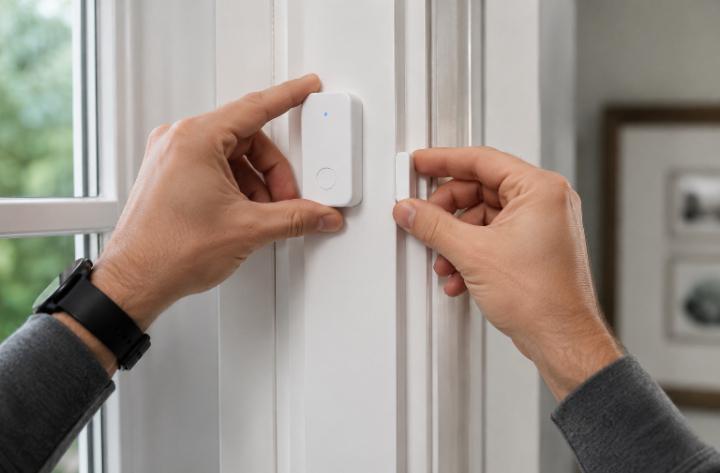
Window security pins, purpose-built key-operated window locks, and magnetic window alarms are all available for under $10 per window at any hardware store. Installing them across all nine of my ground floor windows took one Saturday afternoon and cost $62 total. This is one of the most consistently underrated and overlooked fixes for a high burglary risk score. The complete window reinforcement guide covers every window type and the specific products that work best.
Fix 7: Install a Doorbell Camera With Two-Way Audio Capability
I analyzed my own front door approach pattern and realized that someone could walk up, knock, wait for any response, and leave with confirmation the house was completely empty in under 30 seconds. That is the classic pre-burglary occupancy check. A doorbell camera with two-way audio lets me answer the door from anywhere in the world through my phone, making my home appear fully occupied at any hour regardless of where I actually am.
This is one of the most effective behavioral deterrents available at any price point. The complete DIY doorbell camera installation guide covers the exact positioning and configuration settings I used to maximize deterrence rather than simply recording capability.
Fix 8: Trim All Landscaping to Remove Natural Hiding Spots
I observed my own front garden from a parked car positioned across the street for about 15 minutes. My oversized hedge planted next to the front door created a shadow zone of approximately four feet in width. That shadow zone was large enough for a person to stand completely concealed from the street while working on the door lock area without any neighbor being able to observe them.
I trimmed that hedge down to two and a half feet the following weekend. Free, took about 40 minutes of actual work, and my front door is now completely visible from the road and from both neighboring properties simultaneously. For the full behavioral security habit strategy, read my guide on daily home security habits that make a measurable difference.

Fix 9: Install a Full CCTV System for Complete Property Coverage
A single doorbell camera is not a comprehensive CCTV system and should never be treated as one. After installing my doorbell camera I mapped out my remaining camera coverage and discovered significant blind spots on two full sides of my property. I subsequently installed a four-camera wired system covering my front approach, back garden, side passage, and driveway. Full property CCTV coverage is one of the strongest tools available for addressing a high burglary risk score comprehensively.
I installed the entire system myself in a single day using the complete DIY CCTV installation guide. No electrician was required. No ongoing monthly fees. The entire installation required basic hand tools and about eight hours of focused work.
Fix 10: Actively Change Your Predictable Daily Behavioral Patterns
I tracked my own observable daily routine for a full two-week period by noting exactly what times I left home, what times I returned, and when the house was visibly occupied from the street. The pattern that emerged was so consistent and predictable that I could have set a reliable daily alarm by it. A burglar observing my street for just three days would have known precisely when to approach my property with minimal risk of encountering anyone at home.
Vary your schedule wherever your work and life permit. Use smart plugs to create randomized and varied interior light patterns. Ask a trusted neighbor to park their vehicle in your driveway whenever you travel away from home for extended periods. These behavioral pattern changes cost nothing to implement and can drop a high burglary risk score by up to 15 points through the occupancy signals category alone. My comprehensive guide on how burglars choose their targets explains the specific observation methods they use and how behavioral unpredictability counters them.
Fix 11: Treat Your Garage as the Primary Entry Point It Often Is
I assessed the garage security setup on five homes in my neighborhood and found an identical pattern across all of them without exception. Every single home had a weaker lock on the internal door connecting the garage to the living space than on the primary front entrance. Burglars understand this pattern extremely well. A garage entry is significantly quieter than a forced front door breach and frequently goes undetected for considerably longer.
Install a Grade 1 deadbolt on the internal door between your garage and your home interior. When you are home in the evening, engage a physical slide lock on the garage door itself as a secondary barrier. Never leave your garage door remote control unit visible inside a parked vehicle. These three changes address the garage entry vulnerability that consistently raises burglary risk scores on properties that overlook this access point.
Fix 12: Join an Active Neighborhood Watch or Community Alert Group
This final fix genuinely surprised me when I first saw its measurable contribution to the overall burglary risk score framework. Active neighborhood watch participation is a formally recognized deterrent factor in criminological research and law enforcement policy. Properties located in areas with active and visible watch programs show measurably lower residential burglary rates in peer-reviewed studies comparing comparable neighborhoods.
I joined my local neighborhood Facebook group which functions as an informal but active community alert network. The awareness and information it has provided has been practically valuable on multiple occasions. Two separate suspicious vehicle incidents in my immediate street were flagged and documented by neighbors before either situation escalated further. Community vigilance is a security layer that no piece of hardware or technology can fully replicate or replace.
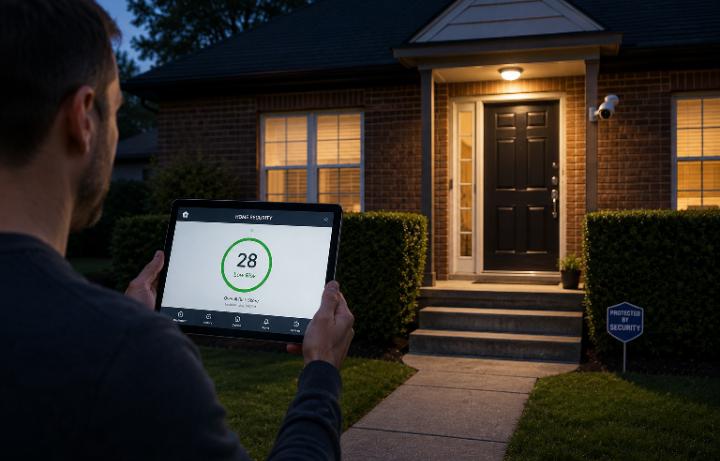
Run the free home burglary risk score assessment and receive a personalized breakdown of exactly which vulnerabilities are raising your score and which fixes will drop it fastest for your specific property.
Conclusion
A high burglary risk score is fixable. I started at a 74 and reached a score of 28 within six weeks by working through these 12 fixes in priority order. Every single one of them was tested, observed, and implemented on my own real property with documented score impact tracked at each stage of the process.
Start with the completely free fixes first including landscaping trimming, behavioral pattern changes, and camera repositioning. Then work through the paid fixes strictly in order of score impact per dollar invested. Use the burglary risk score tool to measure your progress after every phase of work. By the time you have worked through all 12 fixes your home will be a fundamentally different and measurably safer place to live than it is today.
If you received a high burglary risk score when you used the home burglary risk score calculator? And you are currently working through these fixes, I genuinely want to hear about your experience. What was your starting number? Which of the 12 fixes made the single biggest impact on your score? Drop your numbers and your experience in the comments section below. Your honest account helps other homeowners facing the same high score take action with confidence rather than confusion.

Borni Franklin is the founder of LotsHomeGuide and a home security researcher with over 5 years of experience studying real-world burglary patterns, property vulnerabilities, and practical protection strategies. He has tested home security products, analyzed how intruders select targets, and built free tools to help everyday homeowners assess and improve their safety. Every article on LotsHomeGuide is written from hands-on research — not recycled generic advice. Based in the USA. Read full information about Borni Franklin on our About Us page.